One Million Robots, One AI Model: Ericsson and AWS on Autonomous Networks
Ericsson and AWS showcase agentic AI powering one million Amazon robots via 5G and cloud, advancing autonomous networks, proactive customer service, and efficient telecom operations.

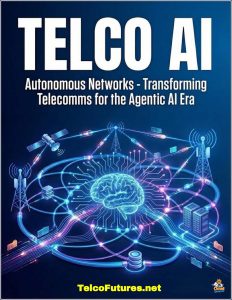 In a concise yet insightful discussion, Peter Linder, Head of Thought Leadership Americas at Ericsson, sits down with Fabio Cerone, General Manager of the Telco Business Unit EMEA at AWS.
The conversation explores the practical integration of artificial intelligence (particularly agentic AI), cloud platforms, and mobile networks—especially 5G—to power next-generation industrial and telecom operations.
The Core Thesis: AI Needs Reliable, Low-Latency Connectivity
The discussion opens by framing the challenge of explaining the interplay between AI, cloud infrastructure, and networks. Cerone emphasizes that agentic AI functions as a “big brain” capable of answering questions, reasoning, and executing actions. This goes beyond generative AI by enabling autonomous decision-making and proactive interventions.
Case Study 1: Scaling Robotics in Fulfillment Centers
A standout real-world example is Amazon’s deployment of over one million robots in its fulfillment centers. These robots handle package movement for next-day delivery. AWS developed a specialized small language model called Deep Fleet to optimize their operations. Key benefits include:
- Preventing collisions between robots.
- Enabling each robot to take the shortest efficient path from point A to B.
- Achieving more than 10% improvement in delivery efficiency.
5G plays a critical role here due to its superior positioning accuracy, security, and reliability compared to other wireless technologies. Precise, low-latency connectivity is essential in dense, dynamic environments where even minor errors could disrupt operations or cause safety issues.
Case Study 2: Transforming Customer Engagement with Agentic AI
The conversation shifts to how agentic AI is reshaping enterprise-customer interactions, using telecom service providers’ contact centers as a prime example. Traditional Interactive Voice Response (IVR) systems—those frustrating “press 1 for this, press 2 for that” menus—are giving way to proactive, intelligent agents.
Key shifts include:
- Moving from reactive (customer-initiated problem calls) to proactive engagement, where the system identifies and resolves issues before the customer notices.
- Resolving core problems in ~10 seconds.
- Converting interactions from painful troubleshooting sessions into positive “grateful moments” for cross-selling, upselling, and trust-building.
This evolution promises higher customer satisfaction and new revenue opportunities for service providers.
rApps as a Service: Toward Autonomous Networks
A major highlight of the Ericsson-AWS collaboration is the launch of rApps as a Service on the AWS Marketplace. rApps (RAN Intelligent Controller applications) are software modules designed to optimize radio access networks (RAN) and enable more autonomous operations.
Current state and vision:
- Most operators today operate at autonomy levels 1 or 2 (basic automation).
- The goal is to reach level 4 (high autonomy) and ultimately “zero touch, zero trouble” operations.
- Agentic AI executes actions on behalf of humans, reducing manual intervention in network management.
By hosting rApps in the cloud, operators gain easier access, scalability, and faster deployment of AI-driven network optimization tools.
Revolutionizing Software Development Workflows
The partnership extends to software development itself. Ericsson and AWS have created a two-sided marketplace for AI-native software development:
- One side: Domain experts upload rich knowledge bases, including customer/product information, 3GPP specifications, and source code.
- Other side: Software developers and agentic AI systems access this knowledge to generate, iterate, and manage software at unprecedented speeds.
This approach dramatically accelerates the software lifecycle, allowing domain-specific expertise to combine with AI capabilities for more efficient development and maintenance of complex telecom systems.
Why This Convergence Matters
The discussion underscores several converging trends:
- Connectivity as the foundation: Reliable 5G (and future 6G) networks provide the low-latency, high-reliability backbone that AI agents and robotics require for real-world action.
- Cloud as the enabler: Provides scalable compute, storage, and marketplace distribution for AI models and applications like rApps.
- AI as the intelligence layer: Agentic systems move operations from reactive/human-driven to proactive/autonomous.
Together, these elements support everything from warehouse-scale robotics to self-optimizing mobile networks and intelligent customer service. The Ericsson-AWS partnership exemplifies how telcos, cloud providers, and enterprises can collaborate to commercialize these capabilities rapidly.
Conclusion
This conversation offers a grounded, example-rich view of the AI-cloud-5G nexus rather than abstract futurism. From one million robots navigating warehouses more efficiently to networks that largely run themselves and contact centers that delight rather than frustrate customers, the message is clear: the integration of agentic AI with robust connectivity and cloud infrastructure is already delivering measurable business value—and the pace is only accelerating.
For telecom operators, enterprises, and technology leaders, the path forward involves embracing these collaborative platforms (such as rApps-as-a-Service and AI-driven development marketplaces) to achieve greater autonomy, efficiency, and customer-centric outcomes.