Bejoy Pankajakshan | Navigating the Journey to the AI Native Telco Future
This transformation represents a pivotal moment for operators seeking to evolve their infrastructure and services.

 Speaking at the AI Native Telco Forum in October 2025, Bejoy Pankajakshan, CTO at Mavenir, explores how artificial intelligence is fundamentally transforming telecommunications networks.
Pankajakshan emphasizes that the industry is at a critical inflection point, where AI is evolving from basic applications, such as security, into a core driver of network autonomy and new business opportunities, particularly as operators prepare for the transition toward 6G.
Pankajakshan frames the discussion around this major shift in the telecom sector. He highlights how AI is moving beyond simple use cases to enable higher levels of network autonomy (Levels 3–5) and to support entirely new business models.
This transformation represents a pivotal moment for operators seeking to evolve their infrastructure and services. Pankajakshan structures the presentation around three central pillars that guide the journey to an AI-native telco future.
AI for Monetization
He explains how operators can generate new revenue streams by running AI-powered features directly on their core network infrastructure, including packet processing, IMS, billing, and customer experience systems. This on-premises approach provides advantages in reliability, lower latency, and cost control, while avoiding risks associated with public cloud dependencies.
Practical examples include real-time or near-real-time services such as in-call and post-call sentiment analysis, fraud detection, call summarization and transcription, and language translation powered by optimized small language models. Through these capabilities, telecom operators can move from simply selling connectivity to offering intelligence-based services.
AI for Operational Efficiency
Pankajakshan notes that most current networks operate at autonomy levels 2 or 3. AI can help advance them toward full levels 4 and 5. This progression leads to reduced staffing requirements, faster problem resolution, and broader operational improvements that lay the foundation for more advanced 6G networks.
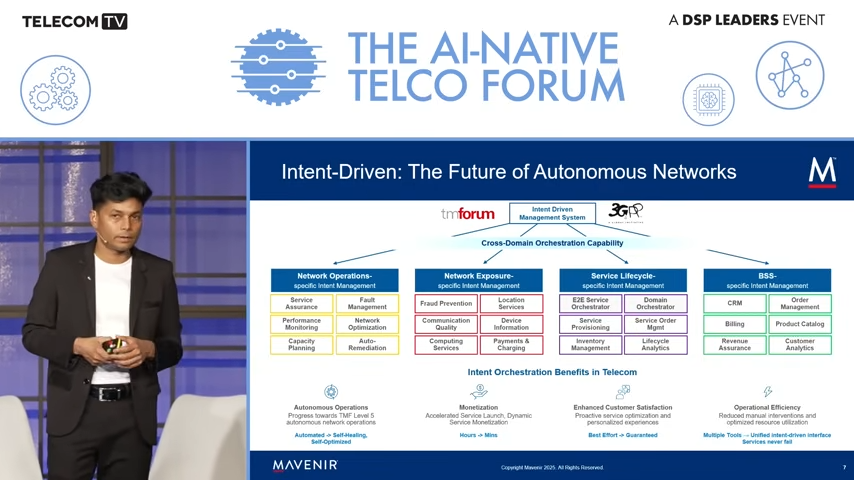
The third pillar focuses on preparing the network for sophisticated 6G use cases, such as enhanced voice services with real-time translation and deepfake fraud detection, along with support for extended reality experiences. A key element is the transition toward intent-driven networks, where users or systems express high-level goals rather than issuing multiple low-level commands.
Evolution of APIs and Network Architecture
The talk also addresses how traditional CAMARA-based APIs, of which there are now more than 60 stable ones, are expected to evolve to support agent-to-agent interactions using protocols like the Model Context Protocol.
This shift enables dynamic negotiation, where AI agents can discover available tools, verify feasibility against network inventory and service level agreements, apply security guardrails, and execute services automatically. Intent-based orchestration extends beyond customer services to network operations, self-healing mechanisms, service lifecycle management, and even business support systems for customer care.
AI-Driven Service Assurance and Data Management
Pankajakshan explains that today’s service assurance systems are largely reactive, relying primarily on fault alarms and performance metrics. In the AI-native future, assurance will incorporate richer contextual information, including application traces, logs, network topology, and a central knowledge graph that draws on historical data from vendors and operators.
This approach will power large language models more efficiently without requiring extensive fine-tuning, enabling proactive identification and resolution of issues in real time. Different stakeholders, from operations engineers to executives, will receive tailored views of the network. To address data challenges, the industry is moving from traditional data lakes toward data fabrics that support zero-copy techniques and selective logging, for instance by using tools like eBPF to capture relevant data only when problems occur.
Organizational and Architectural Changes
In conclusion, Pankajakshan stresses the importance of both organizational and architectural transformations to realize this AI-native future. During the question-and-answer session, he discusses building trust in intent-based systems through negotiation processes and guardrails, the gradual adoption of new protocols, and strategies for optimizing data to improve AI efficiency.