How to Build Agentic Business Support Systems (BSS) Using Microsoft Copilot Studio, TM Forum Open APIs, and Model Context Protocol (MCP)
Mapping TMF standards enables seamless interoperability, allowing AI agents to dynamically access and orchestrate BSS functions like orders, billing, and customer management for autonomous, outcome-driven telecom operations.

 In the rapidly evolving telecommunications landscape, Business Support Systems (BSS) are shifting from rigid, legacy platforms to intelligent, autonomous ecosystems.
This transformation is driven by the rise of “Agentic BSS,” where AI-powered agents handle complex workflows with minimal human intervention, turning systems of record into systems of outcome.
By leveraging Microsoft Copilot Studio for agent orchestration, TM Forum Open APIs for standardized interoperability, and Model Context Protocol (MCP) for seamless integration, telecom operators can build agile, scalable BSS solutions.
Writing here Monte Hong, Microsoft’s Global Director, Telecommunications Industry Strategy, describes how AI and generative AI are revolutionizing telecommunications OSS and BSS, driving automation, predictive maintenance, intelligent customer experiences, and operational efficiency for faster, smarter network management and business processes.
Understanding Agentic BSS
Agentic BSS represents a paradigm shift in telecom operations, where AI agents continuously sense environmental changes, make decisions based on business goals, and execute actions across commercial lifecycles. Unlike traditional BSS, which focus on recording transactions, agentic systems emphasize outcomes like revenue optimization and customer satisfaction.
Core BSS domains include:
- Product and offer catalog management
- Customer and account management
- Order management and orchestration
- Charging, billing, and revenue management
- Partner and ecosystem settlement
Challenges in legacy BSS—such as process coupling, high-volume transactions, regulatory precision, and multi-vendor complexity—often lead to slow product launches and high costs. Agentic BSS addresses these by introducing goal-driven AI agents that operate across domains, enabling autonomous orchestration and real-time adaptation.
Key use cases include:
| Use Case | Description | Impact |
|---|---|---|
| Autonomous Quote-to-Order Orchestration | Agents interpret intent, configure products, and resolve exceptions in real-time. | Reduces cycle times from days to minutes. |
| Intelligent Revenue Assurance | Monitors patterns to detect and correct anomalies before revenue loss. | Minimizes financial leakage. |
| Adaptive Product & Pricing Optimization | Analyzes demand and margins for dynamic recommendations. | Aligns offerings to market conditions. |
| Proactive Customer Lifecycle Management | Predicts churn and triggers personalized interventions. | Improves retention and satisfaction. |
| Partner & Ecosystem Automation | Handles onboarding, compliance, and disputes at scale. | Streamlines B2B2X ecosystems. |
Microsoft Copilot Studio: The Orchestration Layer
Microsoft Copilot Studio is a low-code platform for building, governing, and scaling AI agents. It empowers business users to create goal-oriented agents that integrate with enterprise systems, ensuring security, compliance, and deployment across channels like Microsoft Teams.
Key features:
- Design agents for BSS workflows.
- Secure connections via connectors and APIs.
- Enterprise-grade governance.
- Dynamic integration with external tools.
In telecom, Copilot Studio serves as the control plane for agentic BSS, allowing rapid prototyping and deployment of agents that interact with BSS data.
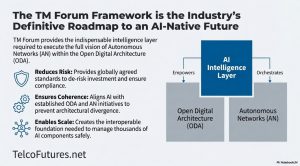
TM Forum Open APIs: The Interoperability Foundation
TM Forum Open APIs are a suite of over 100 REST-based, event-driven, and domain-specific application programming interfaces designed for seamless connectivity in telecom ecosystems. They enable end-to-end service management across lifecycles, supporting scenarios like B2B, IoT, 5G, and NFV.
For BSS, relevant APIs cover:
- Customer management (e.g., TMF632 Party Management)
- Product catalog (e.g., TMF620 Product Catalog Management)
- Order handling (e.g., TMF641 Service Order Management)
- Billing (e.g., TMF678 Customer Bill Management)
- Trouble ticketing (e.g., TMF621 Trouble Ticket Management)
These APIs are technology-agnostic, promoting plug-and-play integration and reducing vendor lock-in. Microsoft actively collaborates with TM Forum to accelerate API development using Copilot technologies, ensuring consistency in multi-vendor environments.
The Role of Model Context Protocol (MCP)
MCP is an open protocol that connects AI agents to external knowledge servers, tools, and data sources. In Copilot Studio, MCP acts as a dynamic control plane, enabling agents to:
- Access BSS tools and data in real-time.
- Automatically sync with evolving APIs.
- Maintain secure, low-maintenance integrations.
MCP complements TM Forum Open APIs by exposing them as agent-friendly resources and tools. For instance, MCP servers can register TMF621 APIs, allowing agents to invoke them without custom coding. Updates on the MCP server are reflected instantly in Copilot Studio, decoupling agents from underlying implementations.
MCP supports:
- Tools: Functions for actions like querying bills or creating orders.
- Resources: Data files or API responses for context.
- Prompts: Templates for task-specific guidance.
TM Forum recognizes MCP as essential for AI-driven BSS automation, aligning with their Open Digital Architecture (ODA) vision.
Real-World Examples
- T-Mobile US Retail Operations: Agents built in Copilot Studio act as copilots for frontline staff, using MCP to access product catalogs (TMF620) and billing data (TMF678), reducing transaction times and boosting sales.
- Exos Systems Platform: A cloud-native BSS solution integrates Copilot Studio with MCP-exposed TM Forum APIs. Agents like Product Expert handle upgrades, while Order Expert automates remediation—demonstrating hybrid human-AI workflows.
- Network Operations Agent (NOA) Framework: Extends to BSS with MCP-integrated TMF621 for trouble tickets, enabling automated resolution in OSS/BSS environments.
These examples highlight how agentic BSS delivers measurable ROI in production.
Conclusion
Building Agentic BSS with Microsoft Copilot Studio, TM Forum Open APIs, and MCP empowers telecom operators to create intelligent, outcome-focused systems. This integration not only modernizes legacy infrastructure but also unlocks innovation in an IQ-driven era. As MCP and TM Forum standards evolve, expect even greater autonomy and efficiency. Telecom leaders should start by piloting MCP servers and agent prototypes to realize these benefits today.