The New Accountability: Navigating the FCC’s Strategic Pivot in Robocall Mitigation
The FCC is enforcing its Robocall Mitigation Database by removing over 1,200 non-compliant providers, blocking their U.S. calls for failing STIR/SHAKEN rules under the TRACED Act.

 By Gerry Christensen, Associate Founder, ICA AI
For years, the telecommunications industry has been locked in a high stakes game of “whack-a-mole.”
While the implementation of STIR/SHAKEN provided a technical framework for call authentication, bad actors have proven remarkably adept at finding the “cracks in the sidewalk”.
These cracks are essentially regulatory and technical loopholes that allow illegal traffic to bypass even the most robust defenses.
Recent activity from the Federal Communications Commission (FCC) suggests we are entering a new era. The Commission’s latest series of Notices of Proposed Rulemakings (NPRMs) represents a shift from purely technical solutions toward a holistic, accountability-based framework. For those of us focused on B2C contact and the integrity of the voice ecosystem, understanding these proposals (Identity/KYC, Number Leasing, International Call Centers, and All-IP transitions) is critical.
Here is an overview of how these pillars are set to reshape the landscape of consumer communication.
1. Identity and the Evolution of KYC
The most foundational shift is the move toward a rigorous “Know Your Customer” (KYC) standard. Historically, many originating providers have operated on a “don’t ask, don’t tell” basis, allowing high-volume callers onto the network with minimal vetting.
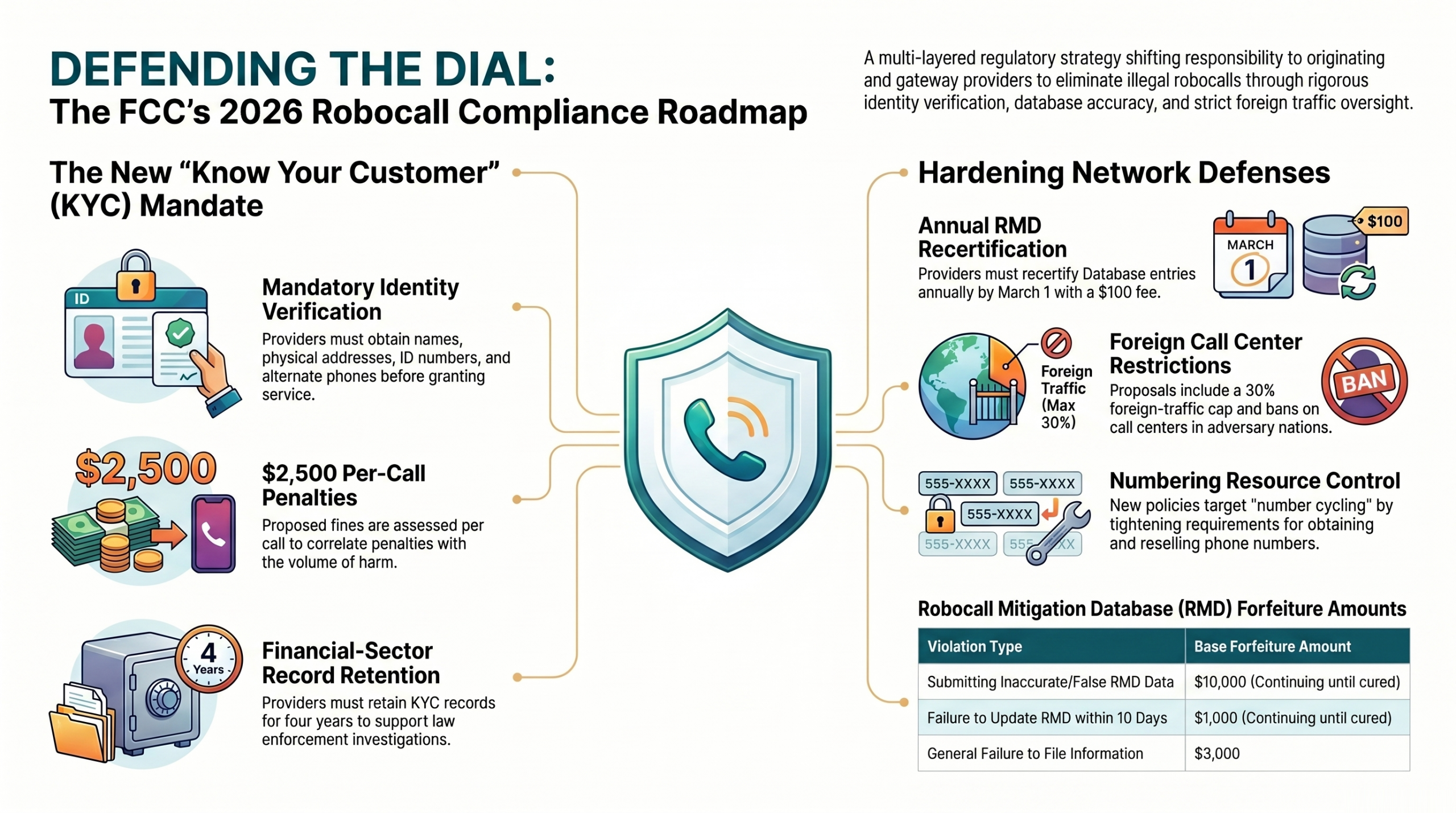
The FCC’s recent KYC proposal seeks to codify what many in the industry have long advocated: a requirement for providers to obtain and verify specific information, including physical addresses, government-issued IDs, and intended use cases, before granting network access. By placing the onus on the originating provider to vet the caller’s identity at the source, the FCC is attempting to solve the “garbage in, garbage out” problem that has plagued STIR/SHAKEN attestation.
2. Closing the Number Leasing Loophole
A major pain point in robocall mitigation has been the ease with which bad actors can acquire and discard telephone numbers. The secondary market for “number leasing” has often allowed callers to hide behind a rotating cast of “clean” numbers, making it nearly impossible for analytics engines to keep pace.
The FCC’s proposed rules on telephone number leasing and numbering resources aim to increase transparency. By requiring greater disclosure from resellers and ensuring that numbering resources are only allocated to entities that are properly registered and compliant, the Commission is effectively “tagging” the tools of the trade. For legitimate B2C enterprises, this could lead to more stable number reputations, as the “noise” from bad actors using similar number blocks is reduced.
3. Hardening the Borders: International Call Centers
Illegal robocalls are an international problem, with a significant volume of scam traffic originating from overseas call centers and entering the U.S. via “gateway” providers. These gateways have often served as the weakest link in the chain.
The FCC’s focus on international call centers and gateway providers involves stricter blocking requirements and “onshoring” accountability. The proposals explore requiring providers to disclose when calls originate from overseas and, in some cases, restricting certain types of sensitive data handling to U.S.-based centers. This creates a “cordon sanitaire” around the domestic network, forcing international traffic to meet the same standards of identity and traceability as domestic calls.
4. The Final Push to All-IP Networks
None of the above measures can reach their full potential if legacy Time Division Multiplexing (TDM) networks remain in the mix. These “analog islands” do not support the metadata required for STIR/SHAKEN, creating “dead zones” where caller ID information can be stripped or spoofed with impunity.
The FCC is now aggressively pushing for the sunsetting of these legacy loopholes. By mandating a transition to All-IP networks, the Commission is ensuring that the technical “plumbing” of the PSTN can carry the identity tokens and KYC data necessary for modern mitigation. For the B2C sector, this means a more consistent experience: a call placed with a “Full A” attestation should maintain that integrity from the moment it is dialed until it rings on the consumer’s handset.
The Collective Impact on B2C Contact
When viewed in isolation, these NPRMs may look like a mountain of new compliance paperwork. However, when viewed collectively, they represent the construction of a Circle of Trust, if implemented thoughtfully and wholistically.
For the legitimate enterprise, the “Wild West” of the last decade has been a disaster. High-volume, high-integrity calls are often caught in the same filters meant for scammers, leading to depressed contact rates and damaged brand reputation. The FCC’s new direction suggests that the future of the voice channel isn’t just about “blocking the bad”; it’s about “identifying the good.”
By tightening the rules around who can get a number, how they are vetted, and how their traffic is carried, the FCC is clearing the way for a more transparent ecosystem. The goal is a world where a consumer can look at their phone and know exactly who is calling and why, representing a shift that is essential for the long-term survival of the voice channel as a tool for business-to-consumer engagement.
Gerry Christensen is an industry analyst and consultant. He has spent over three decades focused on the intersection of network signaling, next generation communications, and identity management.