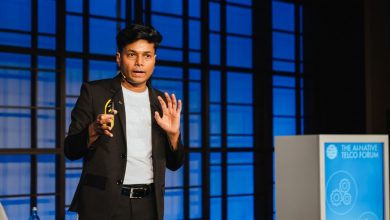
Philippe Ensarguet | Carrier 2.0 – Why Connectivity Is No Longer Enough
The shift is toward a platform approach, where developers can interact with networks programmatically, and customers gain faster, more consistent access to services.

 Connectivity is no longer the end product – it’s the starting point.
In this podcast, Steve Saunders speaks with Philippe Ensarguet, VP Software Engineering at Orange Group, about why telcos are being pushed beyond infrastructure into AI-ready platform models.
As enterprise expectations evolve, networks are no longer judged on bandwidth alone. Philippe explains how AI is emerging as a new layer on top of the telco cloud – enabling richer services, API-driven access, and more seamless, software-led experiences.
The shift is toward a platform approach, where developers can interact with networks programmatically, and customers gain faster, more consistent access to services.
But this transformation isn’t about becoming a hyperscaler. Orange is doubling down on what makes telcos distinct – trusted connectivity, sovereignty, and deterministic systems. In a fragmented geopolitical environment, resilience is becoming a core design principle, shaping how infrastructure, software, and supply chains are built and operated.
The conversation also explores how operating models must evolve. Operators are moving away from tightly bundled stacks toward more flexible, software-centric architectures – with greater emphasis on lifecycle management, observability, and open systems. The result is a redefinition of the telco role: not just connecting users, but enabling secure, resilient platforms for the AI era.
Key Points from the Conversation:
- Connectivity as a starting point, not the end goal: Networks are no longer judged solely on bandwidth. Customers and partners now expect telcos to become AI-ready platform partners, shifting from pure infrastructure providers to enablers of advanced, software-driven services.
- AI as a new layer: Generative AI (still relatively new, only ~4 years old at the time) is layered on top of the telco cloud to support AI workloads. This enables richer, more consistent services, API-driven access, seamless user experiences, developer “superpowers,” enhanced security, frictionless onboarding, and entirely new offerings far beyond basic connectivity.
- Platform approach vs. hyperscaler model: Orange emphasizes a software-centric, automated, API-first model but differentiates itself through trusted, sovereign, and deterministic connectivity. Enterprises value this trust and reliability; they don’t necessarily want telcos to compete directly as hyperscalers.
- Resilience and sovereignty in a fragmented world: In the current “weird” geopolitical climate with multiple power blocks, infrastructure and systems must be built with resilience by design. This involves integrating sovereignty, trust, open-source options (to reduce lock-in and improve supply-chain optionality), and ethical considerations.
- Evolving operating models and vendor expectations: Telcos are moving away from bundled hardware/software stacks from OEMs (original equipment manufacturers) toward pure software practices focused on lifecycle management, updates, deployment, and observability. Open systems are preferred.
- Broader responsibilities: Beyond connectivity, there’s emphasis on ethical and moral duties, including environmental sustainability and minimizing carbon impact when developing or evolving services.
The discussion highlights telcos redefining their role: not just “connecting users,” but providing secure, resilient platforms that support the AI era while leveraging their unique strengths in trusted infrastructure.