NGMN’s AI and 6G Priorities for the Mobile Industry
Laurent Leboucher, chairman of the board at NGMN and group CTO of Orange, outlines the organisation’s current strategic priorities: Network disaggregation, green future networks and 6G.

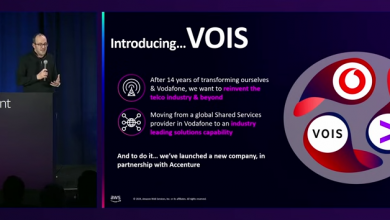
 Laurent Leboucher, as Chairman of the NGMN Alliance Board and Group CTO of Orange, emphasizes that NGMN’s priorities for the mobile industry center on making 6G an evolutionary, flexible, and value-driven platform that integrates AI seamlessly while building on 5G foundations.
He advocates for 6G to prioritize adaptability to handle AI-driven uncertainties, such as unpredictable traffic patterns and evolving use cases, without requiring disruptive overhauls.
Specifically, he states that “flexibility… must be a core 6G design principle.
6G must be able to absorb unpredictable demand patterns driven by AI evolution,” highlighting how AI introduces asymmetries in uplink and downlink traffic, necessitating networks that evolve “towards beyond connectivity” with orchestration, intent awareness, trust, and compute integration.
AI Agents
He further notes the rapid growth of AI and AI agents as both opportunities and challenges, stressing that “it is essential that 6G standards enable adaptability without forcing disruptive architectural changes. Flexibility will be critical to accommodate evolving AI use cases across devices, networks, and regions.”
On the evolutionary aspect, Leboucher views 6G not as a clean-slate redesign or hardware-driven reset but as a “seamless evolution — fully compatible with 5G and propelled by continuous software innovation.”
He calls for decoupling hardware and software roadmaps, with hardware investments being value-driven and sustainable, while software advances are faster and demand-led to address societal needs, avoiding the hype and underutilization seen in past generations.
Platform Mindset
This platform mindset positions 6G as software-defined, enabling modular upgrades, AI-powered spectrum intelligence for real-time traffic optimization, and open APIs for “Network-as-a-Service” models with features like quality-on-demand, real-time billing, and automation.
Regarding AI priorities, Leboucher underscores AI’s dual role: as a workload reshaping network demands (e.g., high-throughput training and low-latency edge inference) and as an enabler for network efficiency, predictive maintenance, energy savings, and resilience.
He anticipates “agent-based communication” in the 6G era, requiring standardized architectures for agent discovery, identity, policy, and trust, while pushing for “AI for networks” to automate operations and transform organizational models. Sustainability is intertwined, with calls for sustainable AI practices, energy management, and green future networks that balance performance with climate responsibility.
Overall, he insists 6G must be operator-driven, focused on tangible value for customers, enterprises, and societies, rather than pure technology push, to ensure economic viability, interoperability, and long-term investment protection.