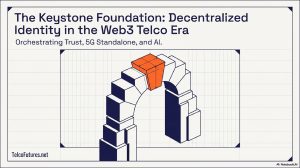
Decentralized Identity – Keystone Foundation for the Telco Web3 Opportunity
Decentralized Identity (DID), grounded in Self-Sovereign Identity (SSI) principles, emerges as the keystone enabling telcos to transition from “dumb pipes” to indispensable trust anchors in the Web3 economy.

 Telecommunications operators face intensifying pressure: connectivity is commoditizing, average revenue per user (ARPU) is stagnating, and capital expenditure for 5G/6G infrastructure continues to rise while traditional revenue models erode.
Meanwhile, Web3—built on blockchain, tokenization, decentralized autonomous organizations (DAOs), and user-owned data—promises a fundamental shift toward decentralized infrastructure, digital assets, and verifiable value exchange.
Yet Web3’s core challenge is trust: without reliable, portable, and privacy-preserving identity, onboarding, compliance, fraud prevention, and interoperability remain fragile.
Decentralized Identity (DID), grounded in Self-Sovereign Identity (SSI) principles, emerges as the keystone enabling telcos to transition from “dumb pipes” to indispensable trust anchors in the Web3 economy. Mobile network operators (MNOs) already possess the world’s most battle-tested root of trust—SIM cards, phone numbers, and real-time network lifecycle data.
|
 The Paradigm Shift: From Pipe to Platform
The Trusted Identity Opportunity
By issuing verifiable credentials tied to this infrastructure, telcos can unlock new revenue streams, reduce fraud, comply with evolving regulations (GDPR, eIDAS 2.0), and position themselves at the center of decentralized physical infrastructure networks (DePIN), metaverse services, and cross-ecosystem data marketplaces.
Key initiatives are underway to develop the standards to position telcos at the heart of this opportunity: For example the GSMA Foundry has launched the Open Verifiable Calling (OVC) project to leverage the foundation of a governance framework proven in financial services: the Legal Entity Identifier (LEI) and the verifiable LEI (vLEI).
In their blog “How Mobile Identity can rebuild our broken online trust model” IDlayr argues that the current online authentication system is fundamentally flawed and that mobile identity offers a practical way to restore trust.
They describe that online trust is severely damaged due to reliance on outdated, human-dependent methods like email + passwords and traditional MFA, approaches that make humans the weakest link. Instead by leveraging the existing, cryptographically secure infrastructure of mobile networks to shift authentication from knowledge-based factors to strong possession-based factors Telcos can establish themselves as the lynchpin to secured digital identity.
What Decentralized Identity Actually Is
Unlike centralized identity systems (where service providers or governments control and store user data), SSI gives individuals full control. Standards from the W3C and Decentralized Identity Foundation (DIF) define the architecture:
- Issuer (e.g., a telco or government) cryptographically signs verifiable credentials (VCs) proving attributes such as phone number ownership, age, or KYC status.
- Holder (the user) stores these credentials in a personal digital wallet on their device.
- Verifier (any Web3 dApp, call center, or service) requests selective proofs. The holder discloses only what is necessary—often via zero-knowledge proofs—while the verifier checks cryptographic validity against a public blockchain ledger without ever seeing or storing the underlying data.
The blockchain acts solely as a tamper-proof registry of public keys and revocation lists; sensitive personal information never leaves the user’s wallet. This model eliminates username/password fatigue, reduces data breach risk, and enables portable, interoperable identity across platforms.
Telcos’ Unique Position as Identity Issuers
No other industry matches telcos’ scale and trust foundation. With billions of active SIMs globally, operators already perform rigorous KYC during onboarding, maintain real-time control over number assignment, porting, and device authentication, and operate secure APIs (e.g., Number Verify, SIM Swap detection) under frameworks like GSMA Open Gateway. GSMA explicitly recognizes that “Mobile Operators are well placed to support and play a role in the operation of a commercial decentralised identity framework.”
This positions telcos as natural root-of-trust issuers—far stronger than social logins or email verification in a Web3 world plagued by sybil attacks and fake accounts.
Web3’s Identity Gap—and Telcos’ Opportunity
Web3 applications require:
- Trustless yet compliant onboarding (KYC/AML without central databases)
- Privacy-preserving verification for DeFi, NFTs, metaverse access, and DAOs
- Secure device and machine identities for IoT/edge networks
- Portable reputation and credentials across chains
Traditional telco identity silos cannot scale here. Centralized databases create single points of failure, expose operators to massive liability, and violate data-minimization principles. DID solves this natively while creating monetizable services:
- Identity-as-a-Service (IDaaS): Telcos issue and certify credentials for third-party Web3 platforms, charging per verification or subscription.
- Fraud mitigation: Real-time SIM-based revocation stops CLI spoofing, account takeovers, and synthetic identity fraud.
- Data marketplaces: Users consent to share anonymized attributes (via ZK proofs); telcos facilitate and take a platform fee.
- DePIN integration: Operators participate in decentralized wireless networks (e.g., World Mobile) by providing verified node identities and coverage credentials.
Nokia’s Technology Vision highlights that mobile operators are “well-positioned to play a crucial role in supporting and operating decentralized identity frameworks,” with Gartner forecasting at least 500 million smartphone users regularly using DLT-based digital identity wallets by 2026.
Real-World Proof: The Trusted Caller Identity Pilot
A compelling demonstration is the joint proof-of-concept by GSMA, Telefónica Tech, TMT ID, and Dock Labs. Here, the mobile operator acts as issuer, cryptographically signing a verifiable credential proving phone-number ownership to the user’s wallet (anchored to the SIM). When calling a brand’s contact center:
- The user presents a selective disclosure (“yes, this number is valid and currently assigned to me”) via DIDComm.
- The verifier validates the credential instantly against the blockchain—no OTP, no personal data shared, no call-center agent access to sensitive records.
- Network signals (SIM swap detection, port-out status) enable real-time risk scoring.
Results: Verification drops from 90+ seconds (or 4–5 minutes in complex cases) to near-instant; fraud vectors collapse; user privacy is maximized; and operational costs fall dramatically. Telefónica intends to commercialize the solution, while GSMA is scaling via its Foundry program for global adoption.
This single use case—trusted voice authentication—already demonstrates DID’s power. Extend the same credential to Web3 wallets, DeFi lending platforms, or metaverse avatars, and telcos become the on-ramp for billions of verified users.
Additional High-Value Use Cases
- Privacy-first KYC for DeFi and NFTs: Users prove accredited-investor status or residency without revealing full documents. Telcos reduce their own compliance burden while earning verification fees.
- IoT and 6G device identity: Machines receive DIDs tied to eSIMs, enabling autonomous micropayments and secure edge computing.
- Decentralized roaming and settlements: GSMA’s existing blockchain pilots for wholesale roaming already cut disputes; adding DID layers enables instant, privacy-preserving partner authentication.
- Ethical data monetization: Zero-knowledge proofs allow telcos to sell insights (e.g., aggregated mobility patterns) with explicit user consent—creating recurring revenue without GDPR risk.
Industry analyses project blockchain telecom market growth to $34.8 billion by 2033, with SSI as a primary driver for fraud reduction (up to 99% in roaming authentication) and new Web3 gateways.
Implementation Roadmap and Standards Alignment
Success requires:
- Adoption of open standards (W3C DID, Verifiable Credentials, DIF DIDComm).
- Integration with existing telco assets: eSIM provisioning, Open Gateway APIs, and mobile wallets.
- Hybrid blockchain approaches: permissioned ledgers for enterprise trust, public chains for broad interoperability.
- User-centric UX: seamless wallet onboarding via carrier apps.
Regulatory tailwinds help—eIDAS 2.0 in Europe explicitly supports digital wallets and verifiable credentials; similar frameworks are emerging globally.
Challenges and Strategic Imperatives
Interoperability across telcos and chains remains non-trivial. Wallet adoption must overcome UX friction. Regulatory clarity on liability for issued credentials is essential. Yet these are solvable through industry collaboration—precisely GSMA’s historical strength (Mobile Connect, blockchain roaming).
Forward-looking operators should:
- Pilot DID issuance tied to existing SIM infrastructure.
- Partner with DIF, Dock, or Polygon ID for technical stacks.
- Monetize early via B2B verification services and DePIN participation.
- Educate regulators on telco-led SSI as a privacy-superior alternative to Big Tech identity.
Conclusion: From Connectivity Provider to Web3 Trust Layer
Decentralized Identity is not merely a technology upgrade—it is the foundational protocol that lets telcos reclaim strategic relevance in the decentralized internet. By leveraging their unmatched root of trust, operators can issue the credentials that power Web3’s entire stack: secure onboarding, compliant DeFi, trusted metaverse economies, and tokenized infrastructure.
Those who act decisively—building on GSMA momentum, real pilots like Telefónica’s, and standards-ready infrastructure—will capture Identity-as-a-Service revenue, slash fraud losses, and become indispensable partners in the multi-trillion-dollar Web3 economy. Those who hesitate risk becoming commoditized infrastructure again, while new entrants (DePIN projects, Big Tech wallets) capture the identity layer.
The keystone is in place. The question for telco leadership is simple: will you be the issuer that anchors the next internet—or watch others build on top of your network? The window for first-mover advantage is open now, in 2026 and beyond.